

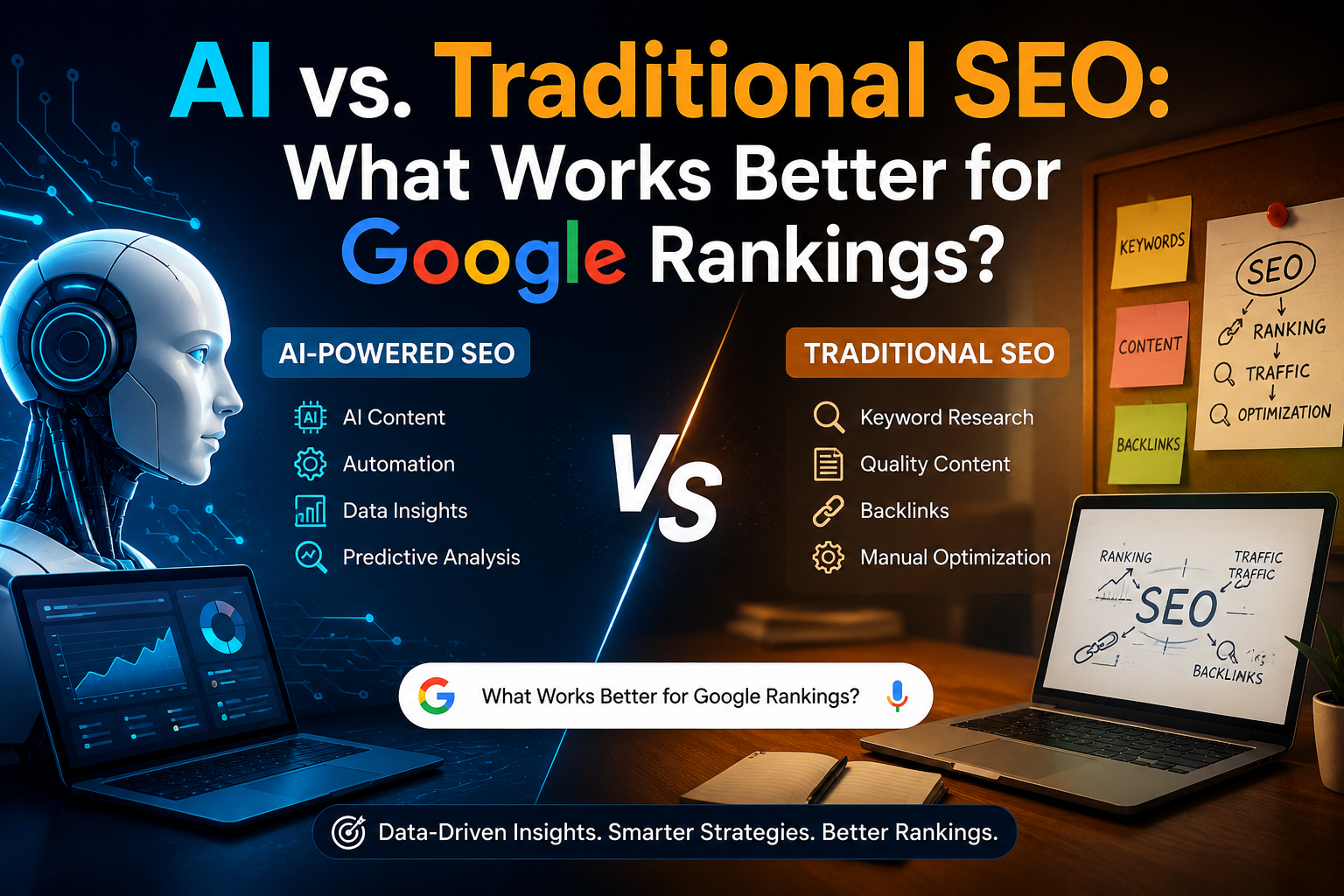
AI vs. Traditional SEO: What Works Better for Google Rankings?
Search has changed. The strategies that worked two years ago are already showing their age. And yet it happened because AI became a driving force behind the way search engines rank content. It does not mean that there is an absolute winner in this case because the AI vs. SEO debate can be regarded from a different point. One should look at the advantages and disadvantages and try to figure out the best way of their combination.
What Traditional SEO Actually Got Right
Traditional SEO built the foundation that modern search still runs on. Keyword research, backlink building, on-page optimization, and technical site health all came from the traditional playbook. Next, these elements didn’t become irrelevant overnight. Google still uses backlinks as a trust signal.
Page speed still affects rankings. Title tags and meta descriptions still influence click-through rates. The core principles didn’t disappear. They just stopped being enough on their own.
Where Traditional SEO Started Losing Ground
The problem with a purely traditional approach is that it was built around patterns search engines used to follow, not the ones they follow now. Stuffing pages with exact-match keywords worked in 2015. Today, it triggers quality filters. Link-building in bulk using low-authority sites was helping boost rankings in 2015. Today, such practices might get one penalized.
For instance, an SEO campaign that focused solely on keyword density and link building in bulk may have seen its traffic dwindling for the last two years.
What AI Brings to the Table That Traditional Methods Simply Can’t
AI-enabled SEO tools analyze data at a scale that would take a human team months to achieve. Some of the differences between the AI-based method and the conventional one include:
- Analysis of gaps in content on hundreds of competing pages in seconds
- Real-time monitoring of SERPs, with changes to the strategy made accordingly
- Prediction of trending keywords that highlight rising topics before they reach their peaks
- Finding technical issues that impact ranking through automated website audits
- Determining the semantic score of content to make sure it matches Google’s AI topic definitions
Apart from these, AI tools help get rid of any guesswork when developing an SEO strategy by basing decisions on live search data.
Real Questions, Clear Answers: The AI vs. SEO Debate Simplified
Q1. Is traditional SEO completely outdated by 2026?
A1. Traditional SEO will not be entirely irrelevant. Such components as backlinks, speed, and on-page optimization will continue to have importance. The problem is in their insufficient use when considering current approaches of AI to evaluating the content of pages.
Q2. Can artificial intelligence tools replace an SEO specialist?
A2. No. AI performs tasks associated with data processing and recognizing specific patterns effectively. Still, it lacks strategic thinking, branding, and knowledge of the target audience’s preferences, which an experienced professional can provide.
Q 3. How do AI tools help to rank faster?
A3. AI-assisted SEO shows quicker outcomes since AI is responsible for finding areas of improvement and identifying the necessary adjustments. Traditional SEO requires time to deliver similar results, especially in competitive markets.
Q4. Does Google penalize websites that use AI tools for SEO?
A4. Google doesn’t penalize tool usage. It evaluates content quality and user experience. Sites using AI tools to produce shallow, unhelpful content get filtered down. Sites using them to strengthen genuine, well-researched content benefit significantly.
The Smartest SEO Strategy in 2026 Isn’t a Choice Between Two Sides
Framing AI vs. traditional SEO as a competition misses the point entirely. Google doesn’t reward the tool you used to create content. It rewards how well that content serves the person who searched for it. Traditional SEO taught marketers how to speak Google’s language.
AI tools now help them speak it faster, more accurately, and at a scale that wasn’t possible before. Build on what worked, automate what slows you down, and keep the focus exactly where Google has always kept it, on genuinely useful content that earns its ranking.


Comments are closed