

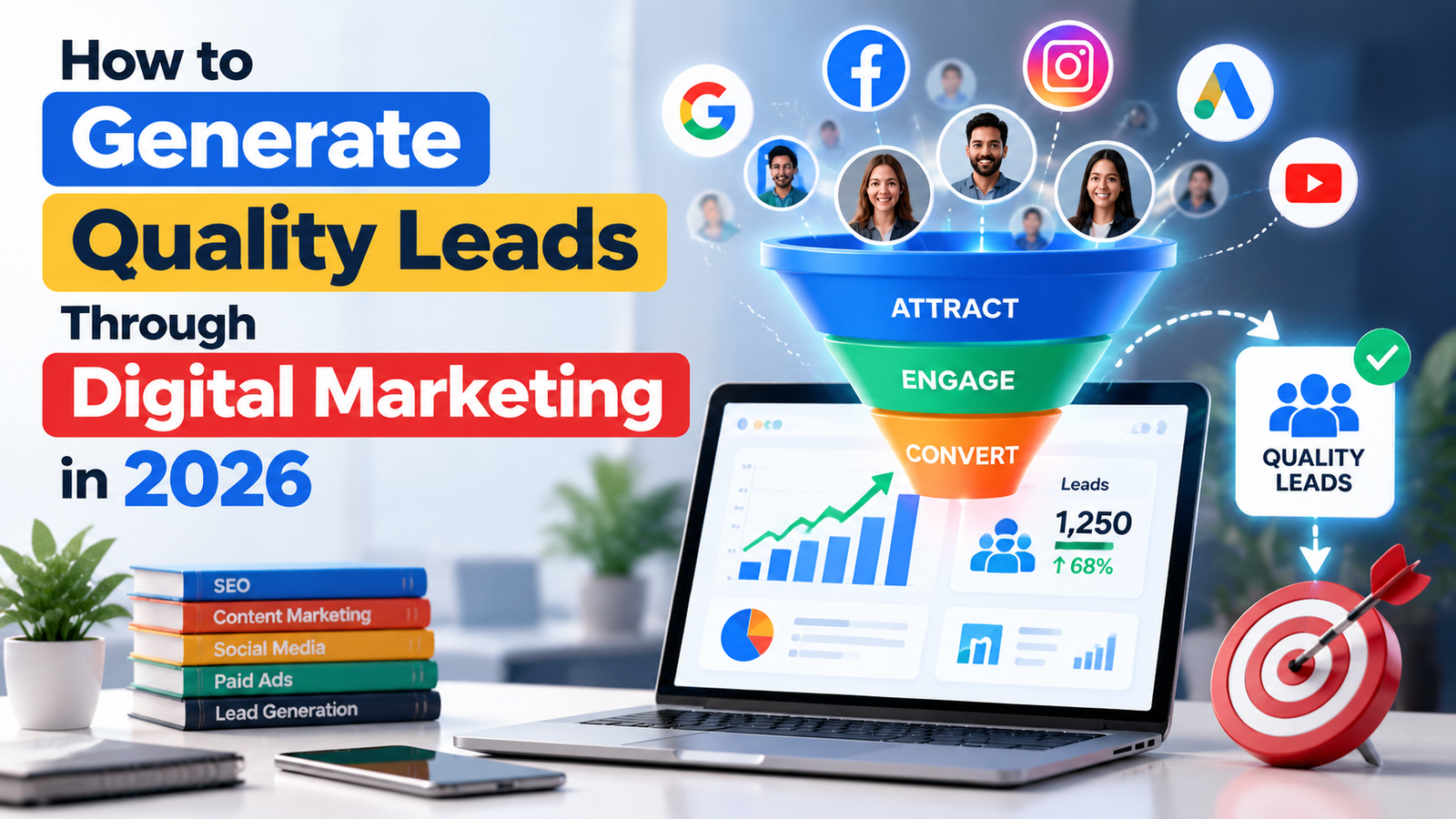
How to Generate Quality Leads Through Digital Marketing in 2026
Generating leads is one of the most important goals of digital marketing. However, getting a large number of leads does not always mean a campaign is successful. Businesses need quality leads—people who are genuinely interested in their products or services and have a realistic chance of becoming customers.
In 2026, digital marketing is becoming increasingly focused on personalization, automation, artificial intelligence, search behavior, and customer intent. Businesses that combine these elements with a strong marketing strategy can attract better prospects and improve their conversion rates.
In this guide, we will explain how to generate quality leads through digital marketing in 2026.
What Are Quality Leads?
A quality lead is a potential customer who matches your target audience and shows genuine interest in your product or service.
For example, if a real estate company sells luxury apartments, thousands of people submitting random forms may not be useful. A better lead would be someone who:
- Matches the project’s target location
- Has the required budget
- Is interested in the property type
- Has a genuine purchase intention
- Is willing to communicate with the sales team
The goal of lead generation should therefore be quality over quantity.
1. Define Your Ideal Customer
Before launching any digital marketing campaign, identify exactly who you want to attract.
Create an ideal customer profile based on factors such as:
- Age
- Location
- Income
- Profession
- Interests
- Buying behavior
- Budget
- Problems and needs
- Purchase intent
For B2B businesses, you may also need to consider company size, industry, job title, and decision-making authority.
A clearly defined audience helps reduce wasted advertising spend and improves the relevance of your campaigns.
2. Create a Strong Value Proposition
People have many options online, so your business needs to communicate why someone should choose you.
Your value proposition should clearly explain:
What you offer + Who it is for + Why it is valuable
For example, instead of using a generic message such as “We provide digital marketing services,” a stronger message could be:
“Performance-focused digital marketing strategies designed to help growing businesses generate qualified leads.”
Your message should be specific, relevant, and focused on the customer’s problem.
3. Use SEO to Capture High-Intent Searches
Search engine optimization remains an important lead-generation channel in 2026.
SEO allows businesses to reach people who are already searching for information, products, or services.
Instead of targeting only broad keywords, focus on keywords that demonstrate strong intent.
For example:
Informational:
“How does SEO work?”
Commercial:
“Best SEO agency for small businesses”
Transactional:
“SEO services near me”
Commercial and transactional searches can be particularly valuable because the user may already be considering a purchase.
Create dedicated landing pages and helpful content around these search queries.
4. Optimize Your Website for Conversions
Getting visitors to your website is only the first step.
Your website should make it easy for visitors to take the next action.
Important conversion elements include:
- Clear headlines
- Strong calls to action
- Simple contact forms
- Click-to-call buttons
- WhatsApp or chat options
- Trust signals
- Testimonials
- Case studies
- Service information
- Fast-loading pages
Avoid making visitors search for a way to contact your business.
A clear CTA such as “Book a Free Consultation”, “Request a Quote”, or “Schedule a Call” can guide visitors toward conversion.
5. Use Paid Advertising Strategically
Platforms such as Google Ads and Meta Ads can help businesses reach highly targeted audiences.
However, successful paid advertising requires more than simply increasing the budget.
Start by defining:
- Campaign objective
- Target audience
- Geographic location
- Budget
- Offer
- Ad creative
- Landing page
- Conversion goal
Your advertising campaign should be designed around the customer’s stage in the buying journey.
Someone who has never heard of your business may need educational content, while someone who has already visited your website may respond better to a conversion-focused offer.
6. Use AI to Improve Lead Generation
AI is becoming an important part of digital marketing.
Businesses can use AI to assist with:
- Audience research
- Content ideas
- Customer segmentation
- Ad copy variations
- Lead scoring
- Chatbots
- Personalization
- Data analysis
- Campaign optimization
However, AI should support your marketing strategy rather than replace human judgment.
Poorly targeted or generic AI-generated content can still attract the wrong audience. The quality of your strategy and data remains important.
7. Create Content for Every Stage of the Customer Journey
Not every potential customer is ready to buy immediately.
A strong lead-generation strategy should address different stages of the buying journey.
Top of Funnel
Focus on awareness and education.
Examples:
- Blog posts
- Videos
- Guides
- Social media content
- Educational reels
Middle of Funnel
Help prospects evaluate their options.
Examples:
- Case studies
- Comparison guides
- Webinars
- Detailed service pages
- Customer testimonials
Bottom of Funnel
Encourage prospects to take action.
Examples:
- Free consultations
- Product demonstrations
- Quotes
- Offers
- Strategy calls
This approach helps businesses build relationships instead of constantly asking cold audiences to buy.
8. Use Social Media to Build Trust
Social media can play an important role in lead generation when used strategically.
Instead of posting only promotional content, share content that demonstrates expertise and builds credibility.
You can publish:
- Educational posts
- Customer success stories
- Behind-the-scenes content
- Industry insights
- Short-form videos
- FAQs
- Product demonstrations
- Expert tips
The objective should be to give potential customers a reason to trust your business before they contact you.
9. Improve Lead Forms
Long and complicated forms can discourage potential customers from submitting their information.
Ask only for the information you actually need.
Depending on your business, a lead form may require:
- Name
- Phone number
- Location
- Service required
- Budget
- Preferred contact time
For high-value products or services, additional qualification questions can help filter out low-quality leads.
For example, a real estate campaign could ask about preferred location, property type, and approximate budget.
10. Focus on Lead Qualification
Generating leads is only part of the process.
Businesses also need a system for identifying which leads are worth following up with first.
Lead qualification can be based on:
- Budget
- Location
- Need
- Purchase timeline
- Product interest
- Engagement
- Decision-making authority
A lead scoring system can help sales teams prioritize prospects who are more likely to convert.
11. Use CRM and Lead Tracking
A CRM can help businesses organize and manage leads throughout the sales process.
Instead of keeping leads in spreadsheets or scattered WhatsApp conversations, businesses can track:
- Lead source
- Contact information
- Follow-up history
- Lead status
- Sales stage
- Assigned salesperson
- Conversion status
This makes it easier to understand which marketing campaigns are producing actual business results.
12. Retarget Website Visitors
Many visitors will not convert during their first interaction with your business.
Retargeting allows businesses to reconnect with people who have already interacted with their website, social media content, or advertisements, where applicable.
Retargeting campaigns can promote:
- Testimonials
- Case studies
- Special offers
- Product benefits
- Consultation opportunities
- Additional educational content
Because these audiences have already shown some interest, retargeting can often be more relevant than targeting completely cold audiences.
13. Build Landing Pages for Specific Campaigns
Sending every advertisement to your homepage is not always the best strategy.
Create dedicated landing pages that match the message of your campaign.
For example, if an advertisement promotes SEO services for local businesses, the landing page should specifically discuss local SEO rather than presenting every service your company offers.
A focused landing page can improve relevance and reduce distractions.
14. Track More Than Lead Volume
One of the biggest mistakes businesses make is measuring success only by the number of leads generated.
Instead, monitor metrics such as:
- Cost per lead
- Qualified lead rate
- Cost per qualified lead
- Lead-to-customer conversion rate
- Customer acquisition cost
- Return on ad spend
- Sales revenue
- Lifetime customer value
For example, Campaign A may generate 200 leads while Campaign B generates only 60.
If Campaign B produces 20 customers and Campaign A produces only 5, Campaign B is clearly more valuable.
15. Align Marketing and Sales Teams
Marketing generates opportunities, but sales teams convert those opportunities into customers.
If sales teams do not follow up quickly or do not have enough information about the leads, marketing performance can suffer.
Marketing and sales teams should agree on:
- What qualifies as a lead
- What qualifies as a sales-ready lead
- Follow-up timelines
- Lead assignment
- CRM processes
- Conversion tracking
- Feedback on lead quality
This creates a stronger connection between advertising and revenue.
16. Test and Optimize Your Campaigns
Digital marketing should not be treated as a one-time activity.
Continuously test different:
- Headlines
- Ad creatives
- Offers
- Audiences
- Landing pages
- CTAs
- Lead forms
- Content formats
Use actual performance data to identify what works.
If one audience generates many leads but very few qualified prospects, consider changing the targeting or campaign message rather than simply increasing the budget.
17. Build Trust Before Asking for the Sale
People are more likely to submit their information when they trust a business.
Strengthen trust through:
- Reviews
- Testimonials
- Case studies
- Certifications
- Portfolio examples
- Transparent pricing where appropriate
- Clear business information
- Professional website design
- Consistent brand presence
For high-ticket products and services, trust can be especially important because customers are taking a larger financial risk.
The Future of Lead Generation in 2026
Lead generation is becoming more intelligent and data-driven.
Businesses are moving beyond simply generating as many contacts as possible. The focus is shifting toward understanding customer intent, delivering relevant experiences, qualifying prospects, and connecting marketing activity with actual revenue.
AI, automation, SEO, paid advertising, social media, CRM systems, and analytics can work together to create a complete lead-generation ecosystem.
However, technology alone does not guarantee quality leads. A successful strategy still requires a clear audience, strong messaging, useful content, compelling offers, and an effective sales process.
Final Thoughts
Generating quality leads through digital marketing in 2026 requires more than running advertisements or publishing social media posts.
Businesses need to understand their ideal customers, create relevant content, optimize their websites, use paid advertising strategically, qualify leads, track performance, and continuously improve their campaigns.
The most successful businesses will focus not just on how many leads they generate, but on how many of those leads become customers and generate revenue.
A well-planned digital marketing strategy can help businesses attract the right audience, build trust, improve conversion rates, and create a sustainable pipeline of potential customers.


Comments are closed