

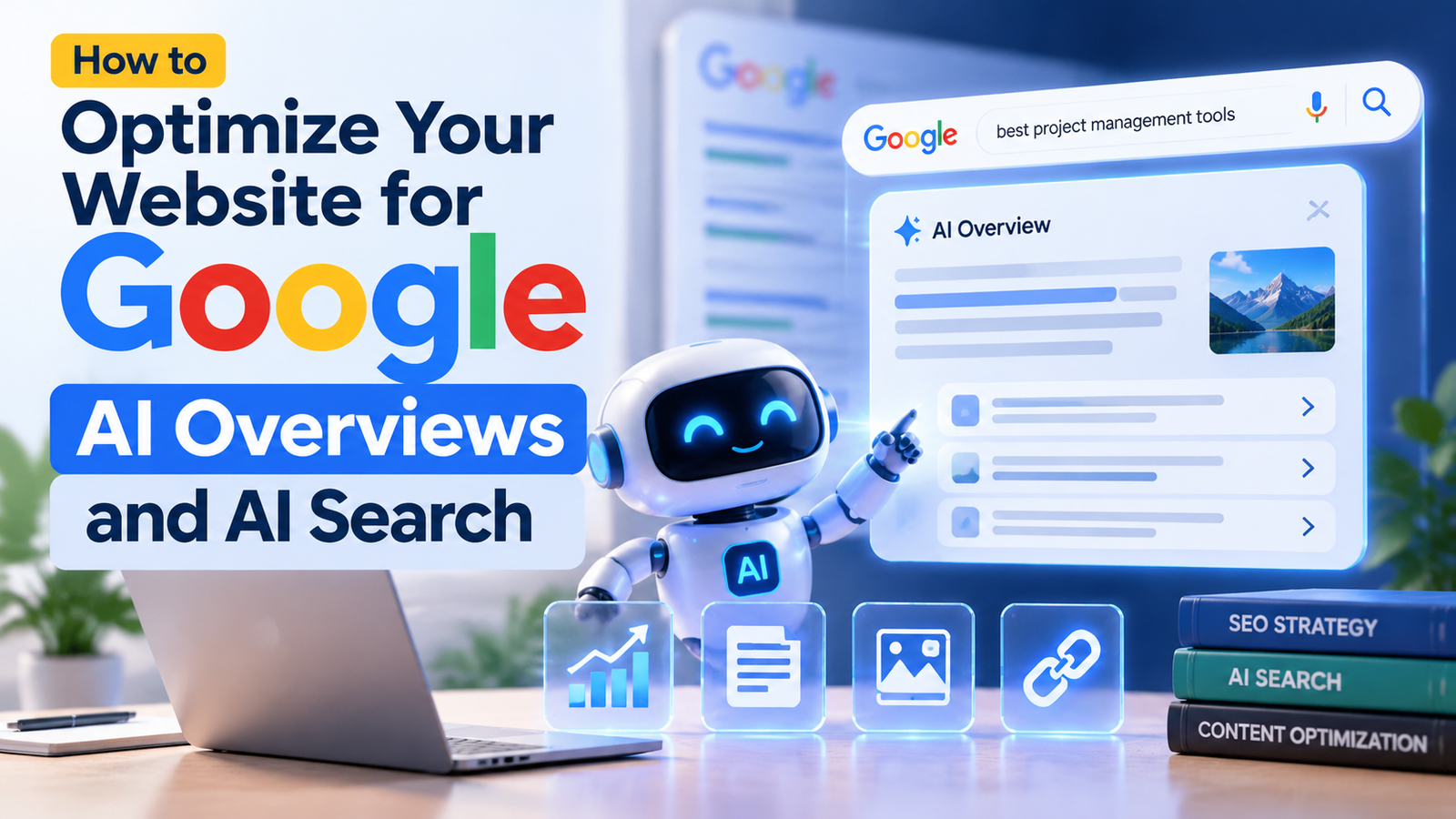
How to Optimize Your Website for Google AI Overviews and AI Search
Search is changing rapidly. Google is no longer relying only on traditional blue links to answer users’ questions. With Google AI Overviews and other AI-powered search experiences, users can now receive summarized answers directly within search results.
For businesses, this means traditional SEO is still important, but it is no longer enough to focus only on rankings. Your website content needs to be structured in a way that helps search engines and AI systems understand, evaluate, and confidently use your information.
So, how can you optimize your website for Google AI Overviews and AI Search?
What Are Google AI Overviews?
Google AI Overviews are AI-generated summaries that appear within certain Google search results. They are designed to provide users with a quick answer or overview of a topic while also directing them to relevant websites for additional information.
Instead of simply displaying a list of websites, Google may analyze information from multiple sources and generate a summarized response.
This creates a new opportunity for businesses. A website may receive visibility within an AI-generated answer even when the search experience looks different from a traditional ranking page.
Why AI Search Optimization Matters
Users are increasingly searching for complete answers rather than individual keywords. They may ask conversational questions such as:
- What is the best SEO strategy for a small business?
- How can I improve my website ranking?
- Which digital marketing strategy is best for real estate?
- How long does SEO take to show results?
AI-powered search systems are designed to understand the meaning and context behind these questions.
This means businesses should focus on creating useful, trustworthy, well-structured content rather than simply repeating keywords throughout a page.
1. Create Helpful, People-First Content
The foundation of AI search optimization is high-quality content.
Your content should be created primarily to help your audience. Avoid writing articles simply to target a large number of keywords.
Instead, understand what your audience wants to know and provide a clear, useful answer.
For example, instead of creating a generic article about “SEO services,” create content that answers specific questions such as:
- How does SEO help local businesses?
- What does an SEO campaign include?
- How long does SEO take?
- How can businesses measure SEO results?
The more clearly your content addresses user needs, the easier it becomes for search systems to understand its value.
2. Answer Questions Clearly and Directly
AI-powered search is particularly useful for answering questions.
Structure your content around real questions your customers are asking. Use descriptive headings and provide concise answers before expanding on the topic.
For example:
What Is Technical SEO?
Technical SEO involves optimizing the technical elements of a website so search engines can crawl, understand, and index its content effectively.
You can then provide additional details below the direct answer.
This structure makes content easier for both users and search engines to understand.
3. Use Clear Content Structure
A well-organized page is easier to understand.
Use:
- Descriptive H1, H2, and H3 headings
- Short paragraphs
- Bullet points
- Numbered lists
- Tables where appropriate
- Clear definitions
- Relevant examples
- FAQs
Avoid creating large blocks of text that make it difficult for readers to find specific information.
A logical structure also helps search engines identify the different topics and questions covered on your page.
4. Build Topic Authority
AI search does not depend only on individual keywords. Search systems need to understand the broader topic and the relationship between different pieces of information.
Create multiple useful pages around your core subject.
For example, a digital marketing agency could create content covering:
- SEO basics
- Technical SEO
- Local SEO
- Keyword research
- On-page SEO
- Link building
- SEO audits
- Google Search Console
- AI search optimization
These related resources can demonstrate deeper expertise around a subject.
5. Demonstrate Experience and Expertise
Trust is becoming increasingly important in search.
Whenever possible, support your content with real experience, original research, examples, case studies, data, and expert insights.
For example, instead of simply stating that a particular SEO strategy works, explain how it was implemented, what challenges were encountered, and what results were observed.
Author information and relevant credentials can also help establish who is responsible for the content.
6. Keep Your Information Accurate and Updated
AI-powered search systems need reliable information.
Review important pages regularly and update outdated statistics, recommendations, pricing, product information, dates, and other time-sensitive details.
If a topic changes frequently, maintaining fresh content can be particularly important.
For example, pages about SEO updates, digital marketing trends, software features, or industry regulations should be reviewed periodically.
7. Use Structured Data Where Appropriate
Structured data helps search engines understand specific types of information on your website.
Depending on the page, relevant structured data may include:
- Organization
- Local Business
- Article
- Product
- Breadcrumb
- Event
- FAQ
Structured data does not guarantee that your content will appear in an AI Overview or special search feature. However, implementing valid and relevant structured data can help search engines interpret eligible information more effectively.
Always follow Google’s structured data guidelines and only mark up information that is actually present on the page.
8. Improve Your Website’s Technical SEO
Strong content cannot perform effectively if search engines cannot properly access or understand your website.
Review important technical SEO factors such as:
- Crawlability
- Indexability
- XML sitemap
- Robots.txt
- Canonical URLs
- Internal linking
- Mobile usability
- Page experience
- HTTPS
- Core Web Vitals
- JavaScript rendering
Regular technical SEO audits can help identify problems that prevent important pages from being discovered or indexed.
9. Strengthen Internal Linking
Internal links help users and search engines discover related content.
For example, an article about keyword research could link to related pages about:
- On-page SEO
- SEO content strategy
- Search intent
- Technical SEO
- SEO audits
Use descriptive anchor text that gives users an idea of what they will find on the destination page.
A strong internal linking structure can also help establish relationships between related topics across your website.
10. Optimize for Search Intent
One of the most important aspects of modern SEO is understanding search intent.
Before creating content, determine what the user actually wants.
Search intent generally falls into categories such as:
- Informational
- Navigational
- Commercial investigation
- Transactional
For example, someone searching “what is technical SEO” probably wants an explanation, while someone searching “SEO agency near me” may be looking for a service provider.
Your content should match the intent behind the search rather than simply targeting the keyword.
11. Include Original Information
AI systems can summarize information that already exists across the web. This makes original information especially valuable.
Consider adding:
- Original research
- Surveys
- Case studies
- Expert opinions
- First-hand experiences
- Unique statistics
- Industry examples
- Original images or diagrams
For example, an SEO agency could publish a case study showing how a specific website’s organic traffic changed after implementing a technical SEO strategy.
Original information gives your website something valuable that generic content may not provide.
12. Optimize for Conversational Search
People often interact with AI search using natural language.
Instead of optimizing only for short keywords, consider the longer questions and phrases your audience may use.
For example:
Traditional keyword:
“local SEO services”
Conversational search:
“How can local SEO help my business get more customers?”
Create content that naturally addresses both variations.
Do not force exact-match phrases into every paragraph. Focus on answering the underlying question naturally.
13. Make Your Content Easy to Quote and Understand
AI-generated answers need information that can be accurately summarized.
Use clear statements, definitions, facts, and explanations.
For example, instead of writing:
“SEO is something that businesses have been using for quite some time and there are many different ways that it can potentially help websites.”
Write:
“SEO improves a website’s visibility in organic search results by optimizing its content, technical structure, and authority.”
Clear writing makes your content easier for people and search systems to understand.
14. Build a Strong Brand Presence
AI search optimization is not only about individual web pages.
A recognizable and trustworthy brand can strengthen your overall digital presence.
Maintain consistent business information across relevant platforms and build genuine mentions, references, reviews, and authoritative links where appropriate.
Your website should clearly communicate:
- Who you are
- What you offer
- Where you operate
- Who you serve
- Why customers should trust you
- How customers can contact you
15. Monitor Your Search Performance
AI search is evolving, so your SEO strategy should evolve with it.
Monitor important performance indicators through tools such as Google Search Console and your website analytics platform.
Pay attention to:
- Organic clicks
- Impressions
- Search queries
- Click-through rates
- Indexed pages
- Organic traffic
- Conversions
- Top-performing content
Do not focus only on whether your website appears in a traditional number-one position. Look at the broader picture of visibility, traffic, engagement, and conversions.
Google AI Overviews and Traditional SEO Work Together
Optimizing for AI search does not mean abandoning traditional SEO.
Technical SEO, helpful content, search intent, internal linking, authority, page experience, and strong website architecture remain important.
The difference is that modern SEO should focus more heavily on being useful, understandable, trustworthy, and contextually relevant.
Think of AI search optimization as an extension of a strong SEO strategy rather than a completely separate discipline.
Final Thoughts
Google AI Overviews and AI-powered search are changing how people discover information online. Businesses that continue producing generic, keyword-focused content may find it increasingly difficult to stand out.
The better approach is to create genuinely useful content, answer questions clearly, demonstrate expertise, maintain accurate information, strengthen technical SEO, and build authority around important topics.
There is no guaranteed formula for appearing in an AI Overview. However, by following strong SEO fundamentals and creating content that genuinely helps users, you can improve your website’s ability to perform in an increasingly AI-driven search environment.
For businesses looking to adapt their SEO strategy to modern search behavior, AdMark Digital Media can help develop a search-focused strategy built around technical SEO, quality content, and long-term organic visibility.


Comments are closed